- Your cart is empty
- Continue Shopping












Applying for an MSc in International Business and Data Analytics is a significant step toward building a career at the intersection of global business strategy and data-driven decision-making. One of the most important parts of your application is your personal statement.
A well-written personal statement demonstrates your academic background, professional experience, career aspirations, and motivation for pursuing the programme. It should convince the admissions committee that you have the skills, experience, and commitment to excel.
In this guide, you’ll find a sample MSc International Business and Data Analytics Personal Statement, practical writing tips, and advice on avoiding common mistakes. Please use this sample as inspiration only and do not copy it directly. Universities expect every personal statement to be original.
We had just finished another hectic month and were sitting around the management table discussing how we had done on sales. The numbers looked positive initially-an overall increase of roughly 18% in terms of revenue when viewed against the previous quarter. However, even though the revenue increased, we saw profits declining, the number of complaints from customers rising, and our running inventory costs increasing at a much swifter rate. As I listened to the conversation it was apparent that we were all making assumptions as none of us could really make sense of the data.

That meeting was the turning point of the way I thought of business. In my experience, the most successful business people have always relied on people skills, common sense and prudent hard work. These attribute still work, but I have also come to realize that winning organizations have to master the art of turning information into strategy.

That day, I started asking various questions. What were the reasons why certain products constantly outperformed others despite less marketing investment? Why did consumers from various countries behave differently? Why did some international markets expand while other remained stagnant? But, crucially, how could organizations use data to find the answers to these questions before large problems and costs arose?

My search for these answers spurred my passion for business analytics. My degree in Business Administration equipped me with valuable knowledge in all areas of business including finance, marketing, operations and organization strategy. However, as I grew in my career I was increasingly aware that today’s business leader needs much more than this traditional management knowledge. They need to be able to read patterns and lay evidence-based strategies rather than relying on gut feelings.

By gaining this insight I was driven to take full advantage of learning wherever possible. I signed up to professional courses on Excel, Power BI, SQL and BI and, when at home I used my evenings copying dashboard layouts from the web and studying publicly available information on how businesses are leveraging predictive analytics to better understand their customer base and enhance business performance. What started out as a curiosity was inspiring me to learn.

A specific experience strongly contributed to this interest. Our firm was not able to improve customer retention despite increasing promotional campaigns investment. Rather than designing specific marketing actions, I looked into past customer sales and interaction history, order frequency and reporting. Even though data were scarce, common trends came out rapidly: customers who got personalized reminder by post were far more likely to repurchase than those who had been targeted by ads.

Sharing these insights with management was very fulfilling, especially because the recommendations were actually adopted. It was satisfying to see a visible uptick in customer participation and the retention figures inch upward within a matter of months. Furthermore, I had the opportunity to witness the impact of data-driven insights directly contribute to the bottom line. The experience made me realize that I wanted to pursue the kind of career that combines strategic thinking and analytical skill.

The decision to study MSc International Business & Data Analytics would be a natural progression of this aspiration. I am especially interested in International Business and Data Analytics as I believe that, in today's business environment, organizations will need to develop a new skill set, blending the strategic insight needed to understand the global market with data analysis.

Apart from gaining cutting-edge technical expertise, I also want to study with students from varied academic, professional and cultural backgrounds. Working in multicultural classrooms would be akin to working in the corporate world, where the best ideas often stem from differing perspectives and backgrounds. I feel that this would help me expand my thinking, while sharing my own professional experiences.

My future goal is to work as a business strategy and analytics consultant to assist companies to grow oversea, on the back of the evidence based decision-making. My vision is to help companies evolve from keeping data to creating a culture where data may influence innovation, optimize client experience and generate sustainable development. I am very keen to help small and medium businesses, most of which are highly capitalized and have tremendous potential to grow but do not have sufficient analysis capability to survive fierce competition.

All I can remember is that meeting where a roomful of supposedly knowledgeable professionals argued over numbers without ever really comprehending them. Now, I no longer view it as one of my particular moments of frustration but rather of my journey. It was the day I found out there's a story behind every spreadsheet and more information to be gained from every dataset to make better decisions.

By doing this MSc I would be able to gain all the required knowledge and the necessary technical, and global, skills to reveal those stories and develop them into efficient business solutions.I look forward to becoming a part of your university and I hope to achieve a significant professional contribution long after I graduate.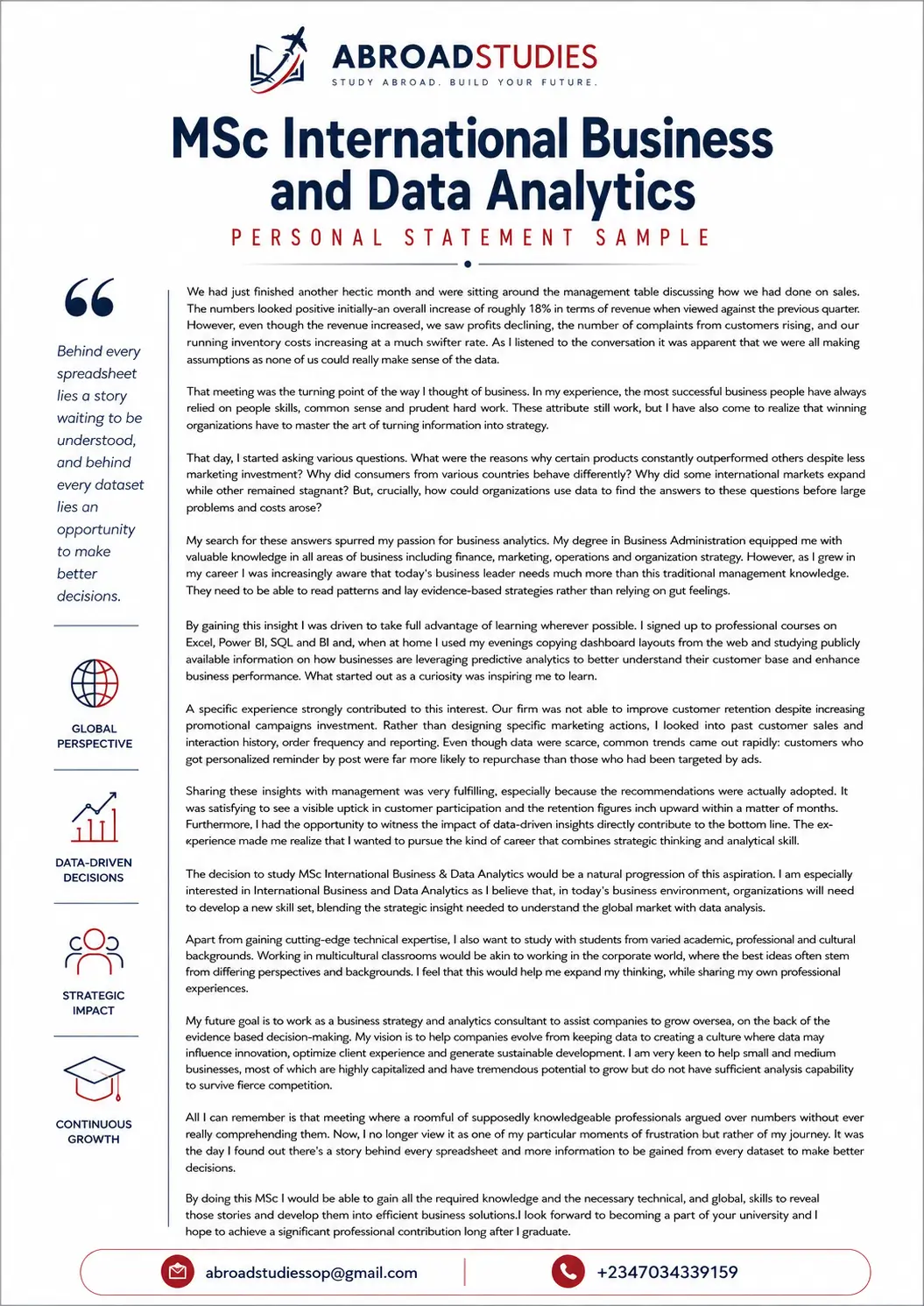
A strong MSc International Business and Data Analytics personal statement should demonstrate more than academic qualifications. It should clearly explain your motivation, career progression, and future goals.
This sample is effective because it:
To make your application stand out, consider the following:
Admissions officers want to understand what inspired your interest in international business and data analytics. Use real experiences rather than generic statements.
Highlight internships, employment, entrepreneurship, research projects, or leadership experiences that relate to business, finance, technology, or data analysis.
Describe how the degree fits into your long-term ambitions and how it will help you create value within your chosen industry.
Explain what attracts you to the university, including specific modules, teaching methods, research strengths, or industry partnerships.
Your personal statement should reflect your unique journey rather than repeating information already found in your CV.
Many applicants reduce their chances by making avoidable mistakes, including:
A compelling personal statement can significantly strengthen your application for an MSc in International Business and Data Analytics. If you need personalised guidance, professional editing, or a fully tailored statement that reflects your background and career aspirations, our experienced admissions writers are here to help.
Get expert assistance today and submit a personal statement that showcases your unique strengths while meeting university expectations.